

Hello
“Animals first entered the imagination as messengers and promises… the aesthetic moment offers hope’… in the act of representing animals in art we are representing, metaphysically something about us…”
~John Berger

Video: Melida Rodas
Live Reading
"Elefante" - A Migration Story
Prosetry - Poems & Prose
This show includes:Melida's Multimedia Art
-
Projections
-
Poems
-
Memmoir
-
Ceramic Sculpture
-
Pottery
Venue:Gallery Bergen
Date: 12/11/26


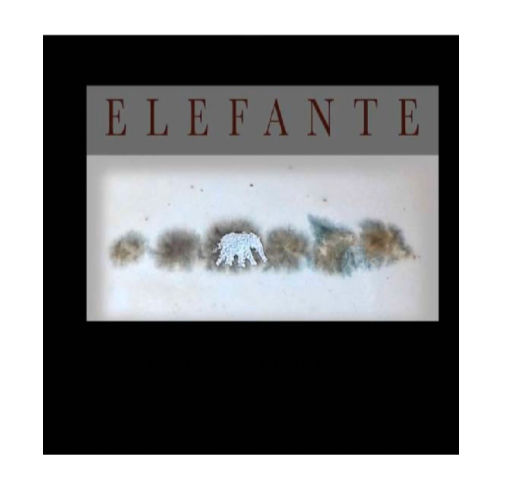


Elefante
Elephant Birth
There is no sound but the whisper of an eyelash closing over a wild, still eye ...
like a moth resting on a tree
legs rock, position, as tail swings
cargo warm for just a few more moments inside,
the membrane
begins to drop,
suspended
a water balloon hanging from a running faucet breaks finally,
suddenly,
spilling the infant onto the ground, red waterfall baptizing motionless mass until mother’s trunk entwines with the innocent
pulling it tugging it to its first breath
new born bones can barely support the weight
larger beast persuading it to move, move, move
their rest will come,
but not for now,
not even for a little while, first to learn how to begin
A kiln is a womb delivering an art object.
While the kiln incubates the mud, a potter can peek at its innards by means of a spy hole. Inside everything glows the color of ambers. I wait for the cycles to expire. A long cooling down process needs end before I can reach inside to release a finished vessel. Removing it prematurely will cause the earthenware to shatter. September begins with me in the ceramic studio, an apron tied around my waist.
Where do I begin?
Memory .
What do I remember? What do I want to tell you? How? I reach inside a barrel. Working the clay I listen closel y to this w et, nothingness mass . What will it say to me?
How will I translate it?
I am the in between.
The messenger.
Where I am is here, yet there again. My Childhood.
In the evenings we could hear the lulling hum of a distant bus, a man tiredly jingling his keys before entering his home,
a cricket, a toad, the whisper of a wind-taken tree,
a Mexican ballad escaping like incense from a nearby window.
My papa would return home late again.
This is when my mama would tickle me with fairy-tales and legends.
I begged her to invent stories for me involving La Mocosita. Mocosita was an elephant I adored.
She lived in a zoo that was founded on the 25th of December 1924. At its entrance gate in script was the word “Aurora,” signifying, new light or sunrise. La Mocosita was an Indian elephant that many children in Guatemala knew well. Her stay at the zoo, as a national treasure, began in 1952. Many mourned her death in 2008.
My sorrow melts over my chest like a cold blue glaze, for in reverie I had lost myself myriad times, with this giant.
Dreaming of her was an escape from the uncertainty that existed in my young family life.
Would we leave or homeland? Would we stay?
Some days, however, came upon us with a cloak of tranquility.
They included a visit with my elephant friend.
From a vendor, papa would buy peanuts in a paper bag. Slowly and tired,
she walked towards me to receive her small gifts.
Her big eyes and lashes,
almost half asleep,
her dusty wrinkles,
how mysterious
their texture and musky scent was to me.
Sometime she seemed sad in her quietness.
What are you thinking my giant friend?
If I place my ear next to your folds will I receive your thoughts?
I want to take you with me.
Let me.
Walk you straight out of this fence, through the park,
into the city streets.
Parade along side the colorful buses with saints on their dash boards,
the rainbow of lanyard wrapped around their steering wheels. Stroll past awnings and windows,
and students and workers. “A donde van? Where are they going?” they would ask.
We might tell them
or simply leave them
to wonder and grin.
We would visit el Palacio National.
Wave hello to the military police.
They seem to never smile, but maybe this would teach them how.
Then to the Museo de Bellas Artes we would go because it's square
like a toy or a box.
Rest a while on the stairs outside the church they call LaCatedral,
because I’m sure the priest would never let us go inside.
Take me Mocosita,
past the Fanta, Coca Cola murals,
beyond the Teleferico,
the airport,
Come with me to Rio Dulce, so I can give you a river bath, ask other children to help me
because you are just so large.
Come with me Mocosita
to the garden behind my house.
Keep me company.
Keep me safe.
Place your chin upon my windowsill.
Watch me sleep.
Wake me.
With your long limb.
To start again.
To Pakistan or Istanbul or Rome,
Just come with me again.
You were my friend.
into the countryside.
Let your trunk hang to the tiles, next to my slippers and dolls.
Travel beyond places with no name
I was quiet. Just like you.
On certain nights when my mama had finished all that she would and I could lie on her cool, milky, tired legs.
“Play with my hair mama. Tell me a tale. Sing me a song, make me sleepy like a snail.” “Bueno, mi amor, a si sera.”
She sang this song to me:
“Un elefante se columpiaba sobre la tela de una arna I vieron que resistia fueron a llamar a otro
elefante. T w o big elephants they liked to s wing on the web of little spider and when they found that it could resist them, they called more elephants to join them.”
Somewhere along the yarn and song, I swung into slumber
on the tenderness
of a web.
I last saw Mocosita in 1979, when at seven years of age I was taken on a voyage, to America, leaving her behind.
Her loss followed me long after. Even now in my adulthood, in the process of creating my ceramic works I am there with her again. I can almost hear the heavy shuffle of her feet, the wetness of her trunk inside my hand. Her presence, a grey comforting shadow, following me in this process. My love for this animal has driven me to create this body of work.
But why this love?
It is a question that has been asked of me in this course many times over.
The answer is simple:
I was her.
She was me.
I wanted to flee.
In my research exploring the elephant as species I find the following facts:
An elephant raised in captivity begins her life tied to a post with a heavy rope or shackle. As the young offspring struggles to break free it quickly learns it is of no use and simply gives up trying. As she grows her keeper slowly diminishes the thickness of the harness. By this time the Mammal has been led to believe that what is holding her is stronger. In the end, bondage by the flimsiest of twine can hold it to a branch or any given place, her will having been broken.
As a child I never could release myself from America.
Here we were made to feel small.
They made us disappear.
At first, I was crippled by fear, shackled by my sense of worthlessness,
then slowly returning I returned to my source of strength: Creativity through Art and Writing.
I have begun again to tell the stories of my childhood. Stories about Mama and Papa, and about the precious days when he gently tied a balloon around my wrist as we happily visited the zoo. From a wooden bench the two of them gazed at the bright colored sphere and me as I called on my elephant companion.
What are you thinking my giant friend?
Will you,
I
take us away From here?
In his Why Look at Animals, writer John Berger proposes, “The animal has secrets which, unlike the secrets of caves, mountains, seas, are specifically addressed to man... but always its lack of common language, its silence, guarantees its distance, its distinctness, its exclusion, from man and of man. Just because of this distinctness, however, an animal’s life, never to be confused with man’ s , can be par allel to his... . With their par allel lives , animals off er a companionship which is different from any offered by human exchange. Different because it is a companionship offered to the loneliness of man as a species.”
It is true. For me this lovely creature was sanctuary, happiness and escape.
Except now here I am, without avoidance, in this creative endeavor.
Facing head on my melancholy childhood,
blending it with my new sense of womanhood through every earthen particle,
finding my ground.
in the moment.
with new insight, new light.
Healing to move forward,
to see outside of my microcosm and to view the panoramic landscape.
While this body of work began as an homage to my Mocosita and my tender memories of her, organically it has evolved. Throughout the process I have become intensely aware of “Elephants” as a species and the paradox of their situation. While these beings are safely kept in zoos and circuses, they are bound to their confinement. Furthermore, in the wild, as they enjoy their natural element, they are massacred for their precious ivory .
Where can elephants roam peacefully?
Where can we immigrants roam peacefully?
My ceramic works offer a sanctuary where they can roam freely and peacefully,
while my prints begin to touch on the subject of their endangerment.
Through my poems I contemplate their grace and majesty.
The words of French American artist Louise Bourgeois fit my case: “the function of memory is not only to recall, reconstitute or reconcile the past but also to construct and represent the present.”
I cannot escape it.
For me it is a beast that is everywhere.
in the folds of sheets, pillow cases left to wrinkle in the drier
smelling of synthetic flowers
the leaves of monstrous plants,
your ears
even in a grotesque dream
a friend of mine sits across the dinner table nibbling at your trunk
the oddity, perplexing me even still
there you are resting
as a tree's thick, protruding root, extending into tusk
even a crumpled paper bag is you.
I see you, in taking you in,
I free you,
as I free myself.
By: MELIDA G. RODAS